Blog Feed

Letter to Minister – Ban floodplain water take

Healthy Rivers Dubbo has written to NSW Water Minister Rose Jackson asking her to immediately ban the highly contentious form of irrigation – floodplain harvesting.

Startling revelations in NSW parliament from the Natural Resources Access Regulator CEO Grant Barnes have thrown into serious question the suitability of the law to stop water theft.

BACKGROUND:

Hansard – NSW Budget Estimates Wednesday 19th August from page 42

ABC NSW Country Hour with Dr Emma Carmody Wednesday 26th August, first story

Media Release Healthy Rivers Dubbo – Ban Floodplain Harvesting Now

Re: Ban Floodplain Harvesting 

Dear Minister Jackson, 

Healthy Rivers Dubbo is a long established grassroots community group providing a strong voice for the rivers and communities of inland NSW. We are writing to you today to ask you to immediately ban the practice of floodplain harvesting water.

It is clear that the Natural Resource Access Regulator is unable to confidently enforce floodplain harvesting regulations following the outcome of two recent court cases. 

Could the Minister please explain how you can uphold your duty under section 9 of the Water Management Act 2000 (NSW), while the current regulatory system is not capable of effectively preventing unlawful or improper water take? 

The significant growth in floodplain harvesting in inland NSW has been identified in many reports as a dominant factor in the mass fish kills at Menindee Lakes, and the sharp decline in wetland health and waterbird populations. The downstream cumulative cultural, environmental and social impact of floodplain harvesting has never been assessed.     

Floodplain harvesting management rules and licencing in NSW is extremely contentious, having been disallowed several times in the NSW Legislative Council including while you were the NSW shadow water minister.

The continuation of floodplain harvesting undermines confidence in the rule of law and in the State’s ability to protect public water resources. 

We look forward to your response. 

Regards, 

The Healthy Rivers Dubbo Committee.

Healthy Rivers Dubbo responds – Murray-Darling Basin Plan 10 year review What We Heard report

Healthy Rivers Dubbo has been extremely disappointed in the Murray-Darling Basin Authority’s approach to the 10 year review of the Murray-Darling Basin Plan. 

We found the discussion paper the Authority released as a guide to submissions led people away from considering the really important questions that the review must legally look at.

With these critical questions not directly asked by the Authority, it is inevitable that the Murray-Darling Basin Plan 10 year review submissions What We Heard report does not reflect the extent by which the Basin Plan is missing it’s legal obligations.

In our submission to the review, Healthy Rivers Dubbo showed unequivocally that: 

  • The objectives of the Water Act 2007 are not being met
    • The Ramsar listed Coorong Lakes, and the Macquarie Marshes are critically endangered and endangered ecological communities, with the Coorong facing a high chance of extinction within 10 years. 
    • The pumping limits were far to high from the beginning of the Plan, and must be bought down significantly as the science says. 
    • Cultural water flows have not been returned to Indigenous people. 
  • The Basin Plan does nothing to address climate change impacts, which are already being felt. Shockingly, the MDBA is not recommending doing anything about that in the next 10 years, despite the Coorong facing a high chance of extinction in the time frame. 
  • Data and modelling used for Basin water management is inaccessible to the public. Particularly in NSW, opaque data is an enormous problem. 

River News

At long last the Macquarie Marshes have been listed as an Endangered Ecological Community under the federal EPBC Act. Only a handful of decades ago, the Marshes would spread over one million hectares in a big flood. At the height of the 2022 flood, they covered about 230,000 hectares. The listing means any new proposal – like keeping more water in Burrendong dam’s flood mitigation zone – would have to be assessed under the EPBC Act. 

The Lower Murray River was listed as Critically Endangered, highlighting the still urgent need to address the problems arising from the over extraction of water from the Basin. 

Water is released from Burrendong dam at a blistering rate. All of the high flows through Dubbo since December have been either destined for the pumps or used as operational water, to move water to a pump. With memories of 2019 when Dubbo was with 8 months of evacuation, Healthy Rivers Dubbo has launched our new campaign Get The Basics Right. We are calling on Water Minister Rose Jackson to make good on her promises – and her legislated duty – to fix our broken water rules once and for all. Our asks are stated here on our website, along with ways you can get involved or support our work. 

Make sure you see the stunning work of artist Ruby Davies at the Western Plains Cultural Centre before the 26th of April. 

‘Rivers Flow to the Sea, to the Sea’ is an exploration into the presence of the Darling/Baaka River through Dubbo-based artist Ruby Davies’ life and the overarching impact it has had on her as an artist. Through a collection of paintings, photographs and mixed-media material, this exploration traces Davies’ continued interaction with the river and the land that surrounds it.

The long awaited Basin Plan Review is happening this year, with the Basin Authority releasing a disscussion paper last week to initiate a 3 month consultation process. With over 100,000 fish dying in Menindee Lakes following an unprecidented heatwave with temperatures between 45 – almost 50 degrees for nine days, it was sobering to read that the Authority are proposing not to consider realigning extraction limits after consider climate change forcast. Learn more about the Basin Plan review from the conservation perspective at the Murray-Darling Conservation Alliance public information webinar  February 17, 2026 6:30pm – 8pm RSVP here

Thankyou for supporting our work – donations are gratefully accepted

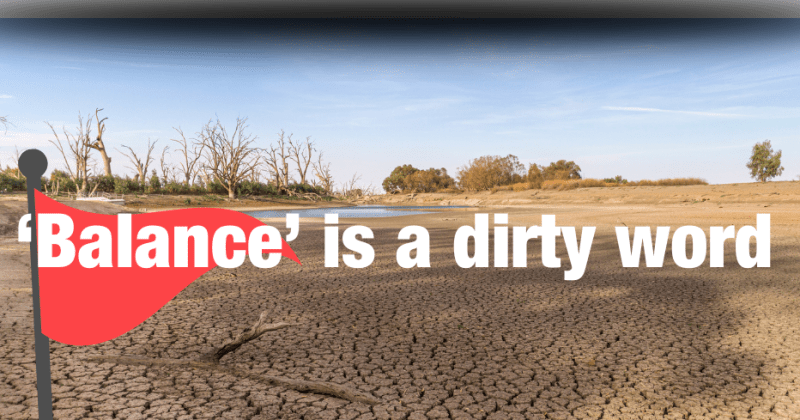
Why ‘balance’ is a red flag word in water talk

Under the NSW Water Management Act 2000, protecting rivers and their dependent ecosystems is a must. This principle reflects a shift from viewing water as solely a resource for human use (such as irrigation) to understanding water as a critical component of healthy ecological systems that must be sustained for the long-term benefit of all.

Key Principle: Prioritising Ecological Health

The Act states that water sharing and management decisions must sustain the health of water-dependent ecosystems, which includes maintaining environmental flows that support natural ecological processes, habitats, and biodiversity. This principle means that ecological sustainability is not just a factor to consider—it is a priority that underpins all water management decisions.

Implication: Environmental Needs Come First

Because river systems are complex and fragile, their ecological requirements often involve maintaining minimum flows, seasonal variability, and connectivity between wetlands and rivers. If these are not maintained, the ecosystem can collapse, leading to irreversible damage. Under the Act, these ecological needs are not negotiable or secondary to economic uses like irrigation. Therefore, allocating water to irrigation at the expense of ecosystem health would be in direct conflict with the Act’s objectives.

Conflict with the Idea of “Balancing” Needs

To say that the needs of the environment and irrigation must be “balanced” implies equal or negotiable trade-offs, which contradicts the Act’s principles. The environment is not just another stakeholder in the system; it is the foundation upon which all other uses—including irrigation—depend. If environmental flows are compromised, all other uses become unsustainable. Therefore, using the language of “balance” incorrectly suggests that it is acceptable to reduce environmental water to support human use, which would violate the legal and ecological intent of the Act.

Conclusion

The NSW Water Management Act 2000 mandates that the ecological requirements of rivers be met as a priority, not simply weighed against irrigation demands. Any management approach that treats environmental flows as negotiable or seeks to “balance” them with consumptive uses risks breaching both the letter and the spirit of the Act. This legal framework insists that healthy river systems must be maintained first, because they are essential for the long-term viability of all water users, including irrigators.

Macquarie/Wambuul Water Security Project

February 2025

Burrendong dam was completed in 1967 with public funding for the purposes of flood mitigation and water supply. The dam is located on the Macquarie/Wambuul River about 30km southeast of Wellington. There is an area of Burrendong Dam that is used to catch floods and release them in a controlled manner, giving communities on the natural floodplains a level of protection from floods.

The Macquarie Wambuul Water Security Project includes an option to use some of this space for additional water storage, mainly for cotton irrigation. This blatant water grab would:

  • transfer billions of litres of water that is currently important natural flows to irrigation.
  • decrease the size of the flood mitigation zone of Burrendong dam and therefore flood protection for the valley.

Healthy Rivers Dubbo strongly opposes this option.

Environmental Impact on the Ramsar Listed Macquarie Marshes

Only when a natural flood occurs do water birds flock to the Marshes in the hundreds of thousands to breed. It’s incredible to see.

These massive nesting events are becoming smaller due to river regulation, having shrunk from events with over a million nests before the dam went in, to about 200,000 at most now. There are significantly fewer wetlands in inland NSW that can host these massive nesting events. Globally, 70% of wetlands have been lost since 1900.

Keeping more water in the flood mitigation zone would cause natural flooding events to be suddenly cut short. This would cause water levels in the Marshes and other wetlands in the catchment to suddenly drop, having a catastrophic impact on mass water bird breeding events.

Flood water has premium environmental value to the entire ecosystem, including the recharge of ground water aquifers. Cutting short flooding events in the Macquarie/Wambuul would have the effect of further sterilising the environment.

Increasing the risk of flooding for Dubbo and Wellington

Reducing the flood mitigation zone increases the risk of an uncontrolled dam spill, which would cause significant damage to property and communities including Wellington and Dubbo. The increased risk of significant flooding in Dubbo would put upward pressure on insurance premiums and erode Dubbo’s reputation as a safe community.

Peer reviewed climate change modelling for the Central West shows flooding will become more extreme in the future – we are already experiencing larger flooding events and downpours:

  • Friday 26th November 2022 a record 220,000 ML flowed into Burrendong dam, that’s almost half of the flood mitigation zone size. If the flood mitigation zone had not been available, significant flooding would have been experienced in Wellington, Dubbo, Narromine and other communities downstream of the dam.
  • The downpours experienced around the weekend of 7th December 2024 in the upper catchment saw people clinging to trees in floodwater in Bathurst, and cars washed downstream near Mudgee.

As the climate warms there will continue to be a growing list of communities who bare economic, social and emotional scaring from increasingly large floods, for example:

  • Eugowra November 2022, two people were killed and about 150 people were airlifted off their roofs when an ‘inland tsunami’ hit the town.  
  • Grantham in the Lockyear Valley Queensland was devastated by a large flood in January 2011 that killed 12 people – the town has since been relocated.
  • Lismore on the North Coast of NSW experienced record-breaking flood that peaked more than 2 metres higher than the record. It was ranked the fourth most costly natural disaster in the world for 2022 – and the second most costly for insurers.

The proposal to reduce the flood mitigation zone in Burrendong dam, exposing all residents along the floodplain downstream of Burrendong dam to increased risk of flooding is wreckless. Communities that are built on floodplains, like Dubbo, must take every opportunity to protect themselves from the worst impacts of increasingly common and severe flooding.

Join Healthy Rivers Dubbo to stay in touch

Comments – NSW Government’s Macquarie Wambuul Water Security Project  

Healthy Rivers Dubbo is pleased to offer our comments on the options for improving water security in the NSW Government’s Macquarie Wambuul Water Security Project.  

Provide a drought reserve in Burrendong Dam to Droughtproof Dubbo

Our preferred option is that a 3 – 4 year drought reserve be established in Burrendong dam to droughtproof Dubbo. All that would be required is for a determined volume of water to be reserved, and when the dam got to that level, only water to keep the river itself and towns provided for would be released.  

At the moment there is an assumption that the dam will fill up every two years regardless of the outlook and of recent droughts, and there’s no rules to stop the dam from emptying down to zero.  

Compared to irrigation, the towns in the Macquarie Wambuul catchment use a tiny volume of water per year, less than 2% of the dam – it is profoundly unjust that entire communities and economies the size of Wellington and Dubbo should be put at risk simply because there isn’t a drought reserve in Burrendong dam.

Based on the limited data that is publicly available regarding water released from Burrendong dam, we estimate that only 11 – 12% of the dam would provide the basics for the river and towns for a year. All that would be required to droughtproof Dubbo for three years is 33 – 36% of the dam.

Expanding the use of groundwater for Dubbo’s water supply  

Groundwater is not a magic pudding and cannot be relied on indefinitely. The groundwater reserves under Dubbo are already drawn heavily on to supplement the water Dubbo draws from the river. During the millennial drought, the Government had to order Dubbo to stop drawing so much water from the aquifer as the levels had dropped dramatically. The extent to which groundwater extraction can be increased must be based on scientifically determined environmentally sustainable limits.

The use of Burrendong dam’s flood mitigation storage to increase water supply

There is an area of Burrendong Dam that is used to catch floods and release them in a controlled manner, protecting towns and property from uncontrolled flooding. There is an option in the project to use some of this space for water storage. Healthy Rivers Dubbo strongly opposes this option, as will not improve water security at all – it will simply mean even more water will be released from the dam and consumed in the same short period of time.  

  • Water supplies would not last any longer than they currently do (i.e. two years), it would just mean that more water would be extracted over the same timeframe 
  • This option would not offer additional water security for the catchment in a drought 
  • Increase the risk of dangerous uncontrolled flooding in Wellington and Dubbo 
  • Catastrophically impact water bird breeding in the Ramsar listed Macquarie Marshes

Pipeline from Dubbo to Nyngan

Healthy Rivers Dubbo accepts the need for a pipeline to Nyngan to secure water supplies out as far as Cobar. However we would prefer to see a pipeline from Warren to Nyngan replacing the Albert Priest Channel, rather than a pipeline from Dubbo to Nyngan.

We are extremely concerned that in a drought, the river would be cut off at Dubbo if that is where the pipeline commenced.

Replace Gin Gin weir

The community resoundingly rejected a proposal for a large new dam to replace the crumbling old wall that remains in the river at Gin Gin.

Any replacement of this old weir must include fish passage, and cannot be any higher, or hold back any more water than the current fixed weir.