

Letter to Minister – Ban floodplain water take

Healthy Rivers Dubbo has written to NSW Water Minister Rose Jackson asking her to immediately ban the highly contentious form of irrigation – floodplain harvesting.

Startling revelations in NSW parliament from the Natural Resources Access Regulator CEO Grant Barnes have thrown into serious question the suitability of the law to stop water theft.

BACKGROUND:

Hansard – NSW Budget Estimates Wednesday 19th August from page 42

ABC NSW Country Hour with Dr Emma Carmody Wednesday 26th August, first story

Media Release Healthy Rivers Dubbo – Ban Floodplain Harvesting Now

Re: Ban Floodplain Harvesting 

Dear Minister Jackson, 

Healthy Rivers Dubbo is a long established grassroots community group providing a strong voice for the rivers and communities of inland NSW. We are writing to you today to ask you to immediately ban the practice of floodplain harvesting water.

It is clear that the Natural Resource Access Regulator is unable to confidently enforce floodplain harvesting regulations following the outcome of two recent court cases. 

Could the Minister please explain how you can uphold your duty under section 9 of the Water Management Act 2000 (NSW), while the current regulatory system is not capable of effectively preventing unlawful or improper water take? 

The significant growth in floodplain harvesting in inland NSW has been identified in many reports as a dominant factor in the mass fish kills at Menindee Lakes, and the sharp decline in wetland health and waterbird populations. The downstream cumulative cultural, environmental and social impact of floodplain harvesting has never been assessed.     

Floodplain harvesting management rules and licencing in NSW is extremely contentious, having been disallowed several times in the NSW Legislative Council including while you were the NSW shadow water minister.

The continuation of floodplain harvesting undermines confidence in the rule of law and in the State’s ability to protect public water resources. 

We look forward to your response. 

Regards, 

The Healthy Rivers Dubbo Committee.
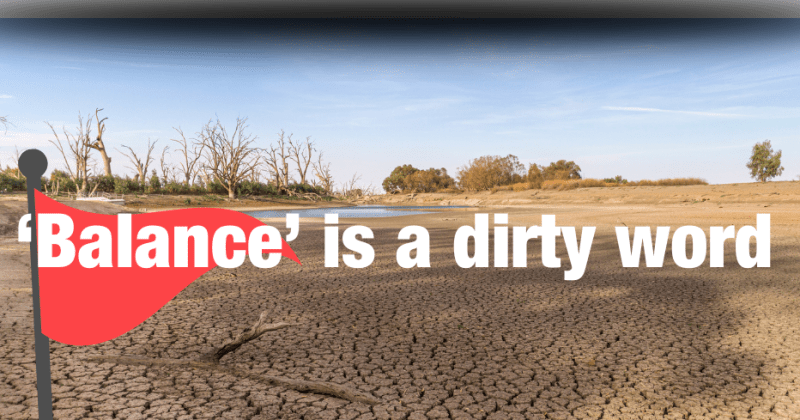
Why ‘balance’ is a red flag word in water talk

Under the NSW Water Management Act 2000, protecting rivers and their dependent ecosystems is a must. This principle reflects a shift from viewing water as solely a resource for human use (such as irrigation) to understanding water as a critical component of healthy ecological systems that must be sustained for the long-term benefit of all.

Key Principle: Prioritising Ecological Health

The Act states that water sharing and management decisions must sustain the health of water-dependent ecosystems, which includes maintaining environmental flows that support natural ecological processes, habitats, and biodiversity. This principle means that ecological sustainability is not just a factor to consider—it is a priority that underpins all water management decisions.

Implication: Environmental Needs Come First

Because river systems are complex and fragile, their ecological requirements often involve maintaining minimum flows, seasonal variability, and connectivity between wetlands and rivers. If these are not maintained, the ecosystem can collapse, leading to irreversible damage. Under the Act, these ecological needs are not negotiable or secondary to economic uses like irrigation. Therefore, allocating water to irrigation at the expense of ecosystem health would be in direct conflict with the Act’s objectives.

Conflict with the Idea of “Balancing” Needs

To say that the needs of the environment and irrigation must be “balanced” implies equal or negotiable trade-offs, which contradicts the Act’s principles. The environment is not just another stakeholder in the system; it is the foundation upon which all other uses—including irrigation—depend. If environmental flows are compromised, all other uses become unsustainable. Therefore, using the language of “balance” incorrectly suggests that it is acceptable to reduce environmental water to support human use, which would violate the legal and ecological intent of the Act.

Conclusion

The NSW Water Management Act 2000 mandates that the ecological requirements of rivers be met as a priority, not simply weighed against irrigation demands. Any management approach that treats environmental flows as negotiable or seeks to “balance” them with consumptive uses risks breaching both the letter and the spirit of the Act. This legal framework insists that healthy river systems must be maintained first, because they are essential for the long-term viability of all water users, including irrigators.