River News

At long last the Macquarie Marshes have been listed as an Endangered Ecological Community under the federal EPBC Act. Only a handful of decades ago, the Marshes would spread over one million hectares in a big flood. At the height of the 2022 flood, they covered about 230,000 hectares. The listing means any new proposal – like keeping more water in Burrendong dam’s flood mitigation zone – would have to be assessed under the EPBC Act. 

The Lower Murray River was listed as Critically Endangered, highlighting the still urgent need to address the problems arising from the over extraction of water from the Basin. 

Water is released from Burrendong dam at a blistering rate. All of the high flows through Dubbo since December have been either destined for the pumps or used as operational water, to move water to a pump. With memories of 2019 when Dubbo was with 8 months of evacuation, Healthy Rivers Dubbo has launched our new campaign Get The Basics Right. We are calling on Water Minister Rose Jackson to make good on her promises – and her legislated duty – to fix our broken water rules once and for all. Our asks are stated here on our website, along with ways you can get involved or support our work. 

Make sure you see the stunning work of artist Ruby Davies at the Western Plains Cultural Centre before the 26th of April. 

‘Rivers Flow to the Sea, to the Sea’ is an exploration into the presence of the Darling/Baaka River through Dubbo-based artist Ruby Davies’ life and the overarching impact it has had on her as an artist. Through a collection of paintings, photographs and mixed-media material, this exploration traces Davies’ continued interaction with the river and the land that surrounds it.

The long awaited Basin Plan Review is happening this year, with the Basin Authority releasing a disscussion paper last week to initiate a 3 month consultation process. With over 100,000 fish dying in Menindee Lakes following an unprecidented heatwave with temperatures between 45 – almost 50 degrees for nine days, it was sobering to read that the Authority are proposing not to consider realigning extraction limits after consider climate change forcast. Learn more about the Basin Plan review from the conservation perspective at the Murray-Darling Conservation Alliance public information webinar  February 17, 2026 6:30pm – 8pm RSVP here

Thankyou for supporting our work – donations are gratefully accepted

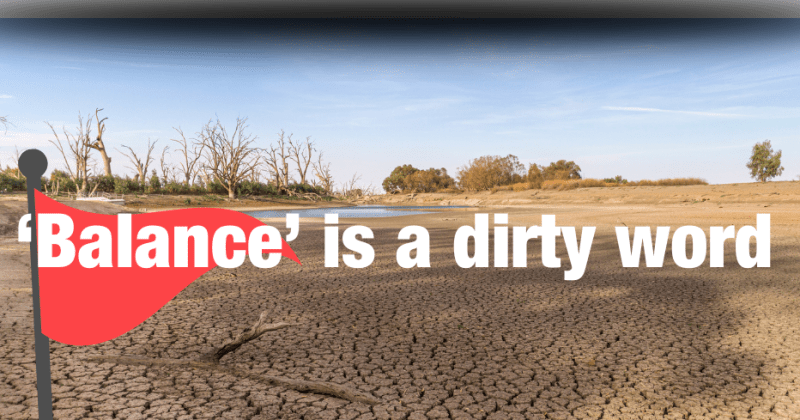
Why ‘balance’ is a red flag word in water talk

Under the NSW Water Management Act 2000, protecting rivers and their dependent ecosystems is a must. This principle reflects a shift from viewing water as solely a resource for human use (such as irrigation) to understanding water as a critical component of healthy ecological systems that must be sustained for the long-term benefit of all.

Key Principle: Prioritising Ecological Health

The Act states that water sharing and management decisions must sustain the health of water-dependent ecosystems, which includes maintaining environmental flows that support natural ecological processes, habitats, and biodiversity. This principle means that ecological sustainability is not just a factor to consider—it is a priority that underpins all water management decisions.

Implication: Environmental Needs Come First

Because river systems are complex and fragile, their ecological requirements often involve maintaining minimum flows, seasonal variability, and connectivity between wetlands and rivers. If these are not maintained, the ecosystem can collapse, leading to irreversible damage. Under the Act, these ecological needs are not negotiable or secondary to economic uses like irrigation. Therefore, allocating water to irrigation at the expense of ecosystem health would be in direct conflict with the Act’s objectives.

Conflict with the Idea of “Balancing” Needs

To say that the needs of the environment and irrigation must be “balanced” implies equal or negotiable trade-offs, which contradicts the Act’s principles. The environment is not just another stakeholder in the system; it is the foundation upon which all other uses—including irrigation—depend. If environmental flows are compromised, all other uses become unsustainable. Therefore, using the language of “balance” incorrectly suggests that it is acceptable to reduce environmental water to support human use, which would violate the legal and ecological intent of the Act.

Conclusion

The NSW Water Management Act 2000 mandates that the ecological requirements of rivers be met as a priority, not simply weighed against irrigation demands. Any management approach that treats environmental flows as negotiable or seeks to “balance” them with consumptive uses risks breaching both the letter and the spirit of the Act. This legal framework insists that healthy river systems must be maintained first, because they are essential for the long-term viability of all water users, including irrigators.